Showing posts with label Bloggosphere. Show all posts

Tuesday, April 21, 2009

Twitter Explosion

Twitter ExplosionDo you use Twitter? In a span of one week, we saw several events unfold in the Twitterverse. These were some of them. Read them through and let me know what you think.

The Celebrity Connection
Ashton Kutcher beats CNN on a race to 1 million Twitter followers. And Oprah joins the Twitter bandwagon.

vs The Corporation
Twitter was used to spread the word against businesses who have done something unacceptable, offensive, or scandalous.

Ever Increasing Exposure
As more people join social media types like Twitter, it gets more powerful. How Twitter will use this power to forward their own interests, it's still not clear right now.

The Twitter Bubble?
Twitter might be getting too big for its own good. And People who started using it because of its exclusivity will be turned off eventually because "everybody is already in Twitter" (as of this time, I am not a user of Twitter).

Twitter-Quitter
As I already wrote about Twitter before. I also wrote how Somebody Hates Facebook. Now somebody hates Twitter.

I personally believe in the exponential power of any network. But for me, I am just gonna it this one out. I've got my hands full with other things right now... who am I kidding? I just don't want to join - no need to make excuses. How about you?

References:
Twitip.com
- Twipocalypse Now: Warnings of a Twitter Bubble

LATimes.com
- Ignore Twitter? Major brands learn they'd better respond -- and quick

Blog.Zap2it.com
- Twitter: Ashton Kutcher passes CNN, Oprah tweets

Blogs.ZDNet.com
- Twitter's Oprah-tunity: Time to get down to busines
- Can Twitter’s backbone handle sudden jump in popularity?
- Twitter’s celebrity appeal: Growth model or downward spiral?
- Twitter and news media: A long-term relationship or just a fling?

News.Cnet.com
- I'm officially dropping out of the Twitter gab fest

Read the rest of this entry

Sunday, March 29, 2009

Comedy Central News

Last time I talked about Comedy Central News, I talked about the clash between Jon Stewart and Jim Cramer. I said on that post that I can get my daily dose of updates and information from Comedy Central News. Well, it seems that a large number of people in America feel the same way too.

Comedy Central News

Nearly one-third of Americans under the age of 40 say satirical news-oriented television programs like The Colbert Report and The Daily Show with Jon Stewart are taking the place of traditional news outlets. Source: RasmussenReports.com
CCN vs CNN anyone? Comedy Central News is both informative and entertaining. Besides this, I have nothing more to say about this than what I already said.

Read the rest of this entry

Thursday, March 26, 2009

Boyet Fajardo and Internet Vigilantism

I just read about the Boyet Fajardo scandal in numerous blog posts available from the internet:

I also noticed the spike on search on "Boyet Fajardo" on Google Trends:

Boyet Fajardo and Internet VigilantismIt reminded me of "8 Awesome Cases of Internet Vigilantism"
Yet another unintended side effect of the web has been the birth of the Internet lynch mob. Now, everything from child abuse to bad customer service can get the online masses whipped into a frenzy of Old Testament-style vengeance. Whether this is good, bad, or downright terrifying, we'll let you be the judge...
(Click here to read the article from source)
Read these blog posts about Boyet Fajardo and Internet Vigilantism and judge for yourselves. As for me, I have learned two things:

1. The internet is an infinitely powerful tool
2. People get better at saying sorry after getting caught on video
-

Read the rest of this entry

Sunday, March 22, 2009

5 Horrifying Tales Of 911 Incompetence

By Adam Brown

article image

We all laugh when some nutjob calls 911 because McDonald's ran out of McNuggets. But the world is full of crazy people, they all own phones and 911 is the one number they all know. We shouldn't be surprised.

No, the horror stories happen when regular folk in an emergency call 911 and find the craziness happening at the other end of the line. For instance. . .

Click here to read the article from source

Read the rest of this entry

Saturday, March 21, 2009

The 7 Most Impressive (And Depressing) Geek Collections

By Luke McKinney

article image


It's no surprise that some people spend retarded amounts of money on their hobbies, and who are we to judge? Maybe video games are more fun on a 108-inch TV.

But then there are the obsessive collectors who, due to some compulsion and/or desire to take their minds off how their lives turned out, spend their lives collecting shit that is both pointless and, worse, no fun...

Click here to read the article from source

Read the rest of this entry

Monday, March 9, 2009

Ideal Number of Friends

What's the ideal number of friends?
By Tom Geoghegan
BBC News Magazine


The more friends you have, the more you earn, says a study. But modern life can allow little time to maintain meaningful relationships, so what's the optimum number of friends?

It's widely accepted that friendships are invaluable to the soul but few of us were aware that they could also boost the bank account.

A study of 10,000 US students over a period of 35 years suggests the wealthiest people are those that had the most friends at school. Each extra schoolfriend added 2% to the salary.

The researchers said this was because the workplace is a social setting and those with the best social skills prosper in management and teamwork.

If a wide circle of friends is taken as a popularity indicator, does that mean the more you have the more successful and happy you are? Or can you have too many? What is the best number?

The average number is about 150, says leading anthropologist Robin Dunbar.

It may sound like a lot, but think of your Christmas card list - 50 cards to 50 couples = 100 friends.

"It's the number of people that you know as persons and you know how they fit into your social world and they know how you fit into theirs. They are a group of people to which you have an obligation of friendship."

They usually consist of an inner circle of five "core" people and an additional layer of 10, he says. That makes 15 people - some will probably be family members - who are your central group and then outside that, there's another 35 in the next circle and another 100 on the outside. And that's one person's social world.

Friendships help us develop as people, says Mark Vernon, author of The Philosophy of Friendship, but the very term "friend" covers a whole range of relationships. You have a very close friendship with your partner but with others it may just be a common interest or history or simply children the same age.

"Aristotle said friends must have eaten salt together and what he meant is there's a sense that people have lived a significant part of their life together. They've sat down and shared meals and the ups and downs of life.

"You really have to have mulled over things with them to become really good friends and there's only so many people you can do that with.

"You can have friends because of what you do together or enjoy something together like football or shopping, but they're not as profound friends as those who you love for themselves because of something in their character. And it doesn't matter what you're doing with them, even sitting alone in a room."

'One in, one out'

There's a limit to how many close friends like this you can have and it's probably between six and 12, he says.

"I think this idea that you can have virtually limitless numbers of friends does water down the concept of friendship. I think it's one of those things where less is more."

Not if you're a socialite like designer Nicky Haslam, who recently threw a party for 800 friends. But even people who don't inhabit the heady world of fashion and celebrity have too many friends to manage.

A newspaper columnist once told of her shock when, having struck up a rapport with a man over dinner, she was told at the end of the meal he had no vacancies for friends. He was operating a "one-in, one-out" policy. Six months later she received a card stating he was now available for friendship.

That's an extreme example but many people view their friendships scientifically and regulate them accordingly.

Julie, a 34-year-old PR consultant in London, says she has three categories of friends. Firstly there are nine close friends - the Premier League - whom she could ring any time of day or night and they would drop everything and come if necessary.

"I try to see them every few weeks and speak at least once a fortnight. I have a rota in my head and try and ring one of them each night as I drive home from work. It shows how pressured we are for time that speaking to friends is multi-tasking."

Julie's next social group has about 20 people, mostly men, whom she would see every couple of months, then there are more than 100 people beyond that on the outer fringes - friends from work, friends from her last job and friends from travelling.

"There are two people whom I don't really want to stay friends with but I don't have the heart to say no to. People I used to work with, they invite you to dinner and then you feel you have to invite them back, but you really don't have the time and it gets really stressful, especially since getting a boyfriend.

"I want to spend two nights a week with him, two nights to myself at home and two nights at the gym, so that leaves one night to see people."

There is a perception that as society has become more mobile, and traditional family bonds have loosened, friendships have become more fleeting. But on the other hand, modern technology has meant we can stay in touch with more people than ever.

"First email, then mobile, and now social networking sites like Facebook have made it much easier for people to grow their circle of friends beyond their immediate inner circle," says digital media expert Dan Clays of BLM Quantum.

"But the swelling is predominantly in the outer-reaches of their circle, and often the fringe group. If you were to examine the profile of someone's group of friends on Facebook, the probability is that a large contingent were accepted as friends out of curiosity and after an initial exchange, the level of dialogue slows down to a trickle."

This is especially apparent in the 16-24 audience group, the digital generation, he says, so it will be interesting to see if they are able to maintain that contact later in life.

But maybe we're too fixated on numbers, says Mr Vernon.

"Ask yourself about the quality of your friendships, not about the quantity."


Article Source: BBC.co.uk

Read the rest of this entry

Friday, February 27, 2009

How To Kill The Music Industry

How To Kill The Music IndustryFile sharing is being argued as one of the main reasons why the music business revenues are continuously in the down trend. From my own experience, even before the popularity of piracy and file sharing, I already noticed that I spend too much money buying cassette tapes and CD's. I realized if I just save the money, I end up feeling less guilty.

The post below talks about the overall trend of technology and how it affects the music industry. Its argument is that the music industry's business model is obsolete and the current changes are inevitable. How about you? What is your opinion on the recent legal battle between the top music industry companies, and Thepiratebay?

How To Kill The Music Industry
Written by Jens Roland

During The Pirate Bay trial, the music industry placed the blame for the decline in their revenues squarely on the shoulders of file-sharers. Their logic is clearly flawed, but it could sway the verdict if no alternative explanation is presented. So, if piracy isn’t to blame, then what is *actually* killing the music industry?

According to Per Sundin, CEO of Universal Music, the decline in music revenues in the past 8 years can be fully attributed to (read: blamed on) illegal file sharing. If this were actually true, many of us might even respect his decision to go after pirates as fiercely as the music industry is doing right now. However, the past 8 years have seen a lot more changes in the landscape of home entertainment than Per Sundin would like to admit, and some of those changes have had a massive impact on music profitability — much more so than any amount of piracy.

Let us refresh our memories and take a look at what actually happened during and just before the past 8 years:

1. First, the explosive rise of computer and console gaming. This competitive ‘third element’ has appeared in the entertainment landscape, beaten both music and movies to the curb and taken a huge cut out of the music industry’s revenues. Consumers don’t have infinitely-deep pockets, and billions of ‘recreation dollars’ that used to go almost exclusively to music, are now going into gaming.

2. International trade agreements have allowed consumers to buy their music across borders, rather than accepting local prices on music based on the ‘relative wealth’ of nations, rather than the actual value of the product.

3. New forms of distributable media, most notably MP3s but also CDs, have become mainstream. These new media don’t degrade over time and rarely break at all, making music rebuys a thing of the past, and allowing the second-hand market for music to thrive and expand - both of which take a cut out of the music industry’s former revenues.

4. Radical technological innovation has taken place in the field of music creation, processing, mixing, and mastering. Recording hardware, CD burners, music software, and media encoders have evolved to the point where most artists can actually afford decent-quality equipment to do their own recording and producing. Furthermore, this has fostered literally thousands of smaller, specialized studios that are challenging the ‘Big 4′ with lower prices, better terms for artists, genre-specific expertise, etc. Successful artists can now leave the big labels and start their own recording outfits on relatively modest budgets. Naturally, super stars like The Beatles or Frank Sinatra have always had this option, but the recent technological advances have lowered the bar drastically. This development is depriving the ‘Big 4′ of many of their former cash cows, who now use the major labels for their advertising and distribution infrastructure alone.

5. The World Wide Web has become an omnipresent force in the world, allowing cheap, end-to-end distribution of digital music, increasingly cutting out the corporate music distributors, who deal in trucks and CD covers, rather than bytes and bandwidth. With iTunes leading the way (very successfully ‘competing with free’, I might add), billions of songs are now purchased digitally rather than physically, no longer necessitating the big labels’ distribution networks.

6. The total number of radio stations, music television networks and other ’streaming’ sources of music has grown exponentially, giving music fans a huge selection of free (and legal) music options. Satellite radio, DAB, and internet radio broadcasts have made it trivial for consumers to simply tune into a channel broadcasting the exact sub-genre of music that they feel like listening to (they can even have a stream created for them dynamically, e.g. on Pandora), making the *purchase* of music entirely optional for the casual listener.

7. A massive selection of entertainment alternatives (home computing, console gaming, mobile devices, etc.) have appeared in the home, effectively marginalizing music as an activity. 15-20 years ago, youths would regularly visit each other just to listen to music together; today, that is virtually unthinkable without some form of activity involved, such as playing Guitar Hero or Rock Band, or dancing at a concert.

8. And finally, the music industry itself has embraced the opportunities of digital media, at last letting consumers buy *single* tracks at a time rather than forcing entire albums full of ‘fillers’ on them. Looking at the RIAA’s own sales figures for the past 10 years, there is a *direct* correlation between the break-off in album sales and the introduction and increase in single track digital sales. Looking at the actual numbers, it is abundantly clear that the vast majority of consumers never wanted to buy full albums in the first place, but were merely forced to by the lack of affordable single-track media. Now that the digital revolution has arrived, countless millions of 16-track album sales are being turned into 1- or 2-track sales, *decimating* the former revenues on music. THIS is the real reason why the music industry is hurting.

In other words: The “it’s common sense” argument that the music industry is peddling in their attempt to tie the declining revenues to piracy, simply doesn’t hold. It is not as clear-cut as the industry believes; the true reason for the decline is something they are still unwilling to face, but will have to face sooner or later:

The fact is that the music industry’s revenues have been artificially inflated for decades because of limited consumer options. The last 15 years of innovation have lifted those limitations, effectively leaving the music industry with an obsolete, defective business model of monopolized production technology, forced album bundling, and almost nonexistent competition in the realm of home entertainment. What is happening now - the decline of music profits and the piracy witch hunt by the music industry - is merely the panicked struggle of a dying business model, a complacent industry’s refusal to accept its diminishing role in a digital world. The pirates are not the reason, and the decline is the not the disease. It is the cure.

This is a guest post by Jens Roland originally posted in Torrentfreak. Jens is a computer scientist by training, but a technology forecaster by trade. He has worked at international think tanks as a consultant and researcher in emerging technologies and has written more than 300 articles and a book on the subject.


———————————————————————-
DATA: Net value of shipped music, in billion dollars

1991 7.83
1992 9.02
1993 10.0
1994 12.1
1995 12.3
1996 12.5
1997 12.2
1998 13.7
1999 14.6
2000 14.3
2001 13.7
2002 12.6
2003 11.9
2004 12.3
2005 12.3
2006 11.8
2007 10.4

(source: RIAA’s annual reports)

Article Source: Torrentfreak

Read the rest of this entry

Sunday, February 22, 2009

The Michael Jackson Auction - Part 3

See more items from The Michael Jackson Auction:
You can judge the man all you want. But I know you'd like to get your hands on some of his stuff. I mean, who wouldn't want his own flight simulation arcade game? Awesome!

June Update: Just a few weeks before the "This is it" farewell concert, Michael Jackson passed away due to cardiac arrest. Watch the famous dancing inmates as they pay tribute to the King of Pop for the lat time - Click here for Michael Jackson's Thriller.

April update: This auction was eventually called off. He had filed suit to halt sale of items from Neverland ranch. All items will be returned back to him. He sold his Neverland ranch last year, but he claims he didn't authorize sale of items.

See Part 1
See Part 2

Michael Jackson's auction: Michael Jackson's marble chess table

A marble chess table supported by four parcel gilt horses on marble pillars. Guide price $2,000-$3,000
Photograph: Shaan Kokin/Julien's Auctions


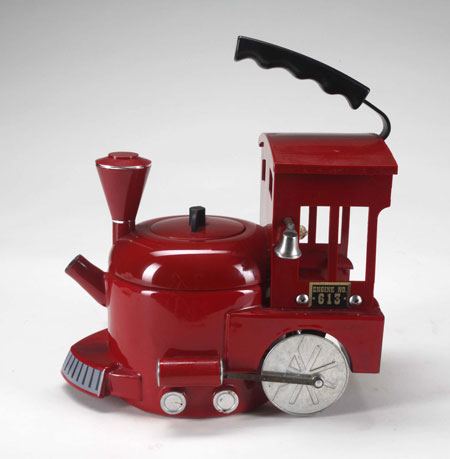
Michael Jackson's auction: Michael Jackson's fire engine tea kettle

A fire engine tea kettle with moving wheels. Guide price $100-$200
Photograph: Shaan Kokin/Julien's Auctions
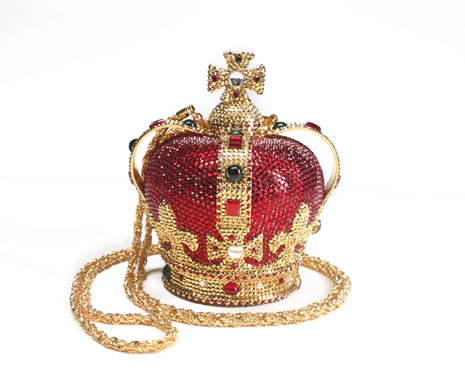
Michael Jackson's auction: Michael Jackson's crown form minaudiere
A Katherine Baumann crown-shaped minaudiere with red, green and gold jewels. Guide price $800-$1,200
Photograph: Shaan Kokin/Julien's Auctions


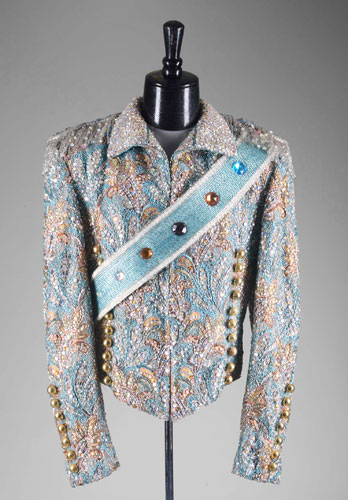
Michael Jackson's auction: Michael Jackson's Victory tour jacket

A Victory tour jacket worn by Jackson at the Kansas City opening of the 1984 tour with the Jackson. It is currently on exhibit at the Los Angeles Grammy Museum. Guide price $2,000-$4,000
Photograph: Shaan Kokin/Julien's Auctions


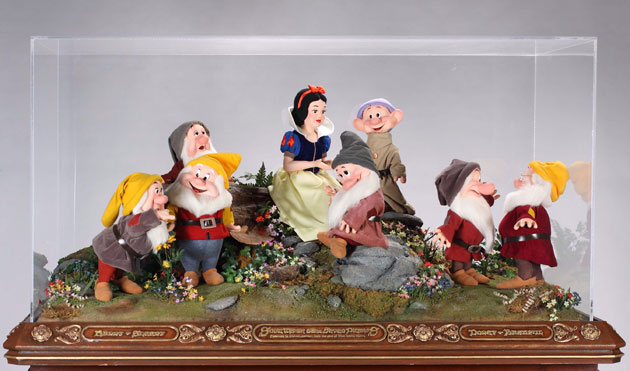
Michael Jackson's auction: Michael Jackson's figures of Snow White and the seven dwarfs

A display of Snow White and the Seven Dwarves in a setting created by the Walt Disney display team. A plaque reads: "Snow White and the Seven Dwarfs Presented to Michael Jackson from the Cast of Walt Disney World". Guide price $1,000-$1,500
Photograph: Shaan Kokin/Julien's Auctions

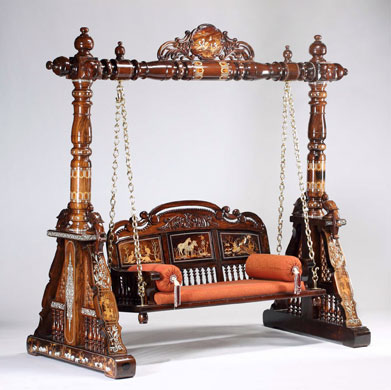
Michael Jackson's auction: Michael Jackson's hanging swing

A hanging swing featuring scenic wild animal panels and elaborate carvings. Guide price $1,200-$1,800
Photograph: Shaan Kokin/Julien's Auctions


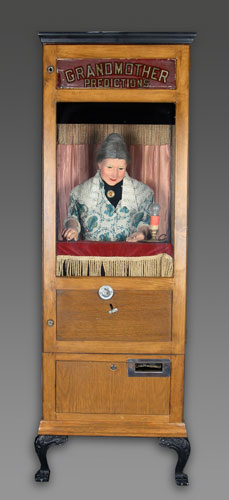
Michael Jackson's auction: Michael Jackson's Coin operated fortune teller

A coin-operated Grandmother Predictions fortune teller in wooden cabinet. Guide price $1,500-$2,500
Photograph: Shaan Kokin/Julien's Auctions
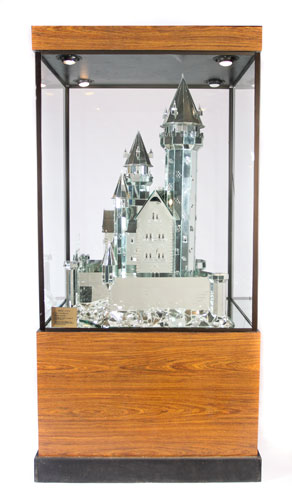
Michael Jackson's auction: Michael Jackson's model of Falkenstein Castle

A mirror model of Falkenstein Castle. Guide price $1,000-$2,000
Photograph: Shaan Kokin/Julien's Auctions

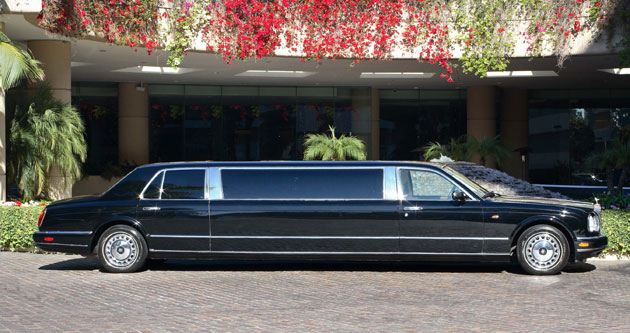
Michael Jackson's auction: Royles Royce with Interior Designed by Michael Jackson

Jackson's Rolls Royce with interior designed by himself. Guide price $140,000 - $160,000
Photograph: Shaan Kokin/Julien's Auctions

Michael Jackson's auction: Interior of Royles Royce Designed by Michael Jackson

Inside the Rolls Royce, as designed by Jackson. Guide price $140,000 - $160,000
Photograph: Shaan Kokin/Julien's Auctions

source: guardian.co.uk

See Part 1
See Part 2

Read the rest of this entry

The Michael Jackson Auction - Part 2

What I learned from The Michael Jackson Auction:

If you have insane amounts of money, you buy lots of crazy stuff. Just take a look at the items up for grabs below.

June Update: Just a few weeks before the "This is it" farewell concert, Michael Jackson passed away due to cardiac arrest. Watch the famous dancing inmates as they pay tribute to the King of Pop for the lat time - Click here for Michael Jackson's Thriller.

April update: This auction was eventually called off. He had filed suit to halt sale of items from Neverland ranch. All items will be returned back to him. He sold his Neverland ranch last year, but he claims he didn't authorize sale of items.

See Part 1
See Part 3

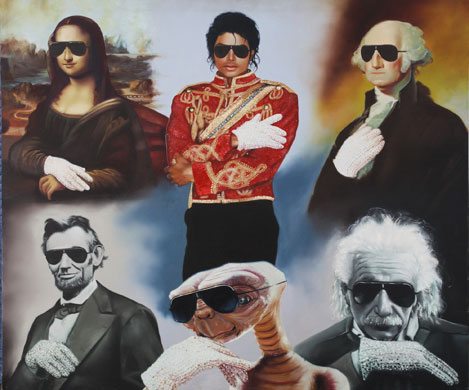
Michael Jackson's auction: Michael Jackson's lookalikes painting

A painting on stretched canvas featuring iconic figures such as Abraham Lincoln and Albert Einstein wearing Jackson's trademark sunglasses and glove. Guide price $1,000-$2,000
Photograph: Shaan Kokin/Julien's Auctions

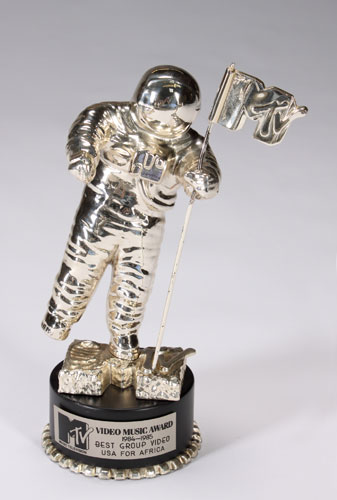
Michael Jackson's auction: Michael Jackson's MTV award

Jackson's MTV Video Music award for Best Group Video USA For Africa 1984-1985. Guide price $6,000-$8,000
Photograph: Shaan Kokin/Julien's Auctions


Michael Jackson's auction: Michael Jackson's Gaggia

A Brevetti Gaggia espresso and cappuccino machine. Two tone metal featuring polished chrome with bands of repoussé and reticulated brass. Tank bears a Neverland plaque, is flanked by decorative Turkish tea vessels and is crested by an eagle finial. Guide price $1,000-$2,000
Photograph: Shaan Kokin/Julien's Auctions

Michael Jackson's auction: Michael Jackson's 'scissorhand' gloves

The prop 'scissorhand' gloves that Johnny Depp wore in Tim Burton's Edward Scissorhands. Stan Winston, the visual effects artist for the film, worked with Jackson on the 1997 short film Ghosts. Guide price $4,000-$6,000
Photograph: Shaan Kokin/Julien's Auctions


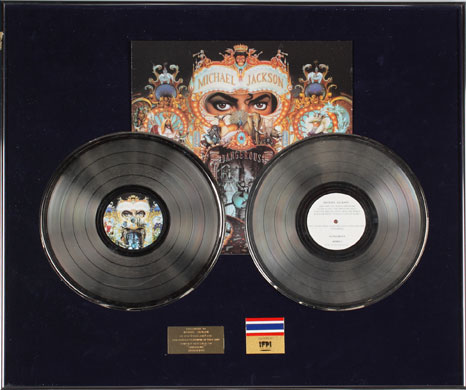
Michael Jackson's auction: Michael Jackson's record awards

A pair of record awards presented to Michael Jackson by Epic (Thailand) for double platinum sales of Dangerous, and gold sales of Bad. Guide price $200-$400
Photograph: Shaan Kokin/Julien's Auctions

Michael Jackson's auction: Michael Jackson's flight simulator

A Sega flight simulation arcade game with safety barrier and attendant station. Guide price $4,000-$6,000
Photograph: Shaan Kokin/Julien's Auctions


Michael Jackson's auction: Michael Jackson's Napoleon statue

A statue of Jacques-Louis David's painting depicting Napoleon crossing the Alps. Guide price $300-$500
Photograph: Shaan Kokin/Julien's Auctions


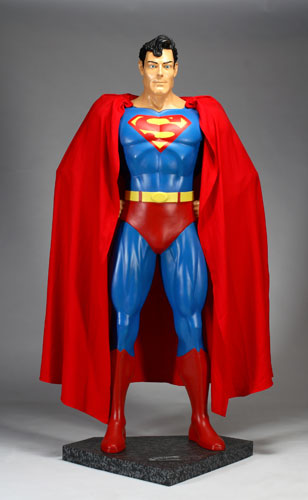
Michael Jackson's auction: Michael Jackson's Superman figure

A larger-than-life figure of Superman. Guide price $1,000-$1,500
Photograph: Shaan Kokin/Julien's Auctions
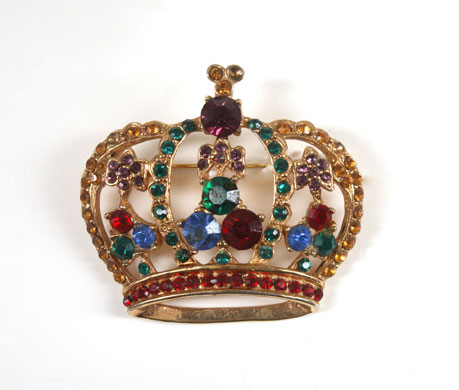
Michael Jackson's auction: Michael Jackson's crown brooch
Jackson's gold metal crown brooch set with multicoloured faceted stones. Guide price $80-$120
Photograph: Shaan Kokin/Julien's Auctions

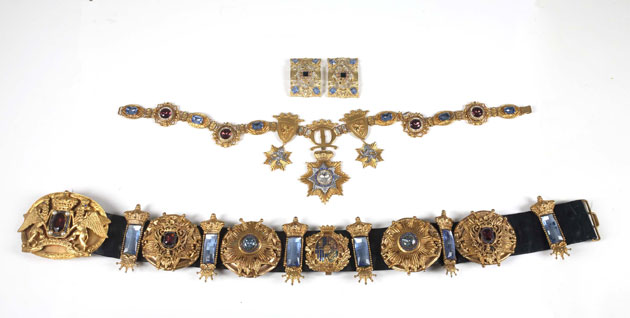
Michael Jackson's auction: Michael Jackson's Moonwalker accessories

Accessory pieces from Jackson's Moonwalker costume including: a black leather and gold metal belt, a gold metal necklace with matching purple and blue stones and matching bracelet and rectangular epaulets. The belt can be seen in the opening sequence of the film Moonwalker. Guide price $1,000-$1,500
Photograph: Shaan Kokin/Julien's Auctions


source: guardian.co.uk

See Part 1
See Part 3

Read the rest of this entry

The Michael Jackson Auction - Part 1

What I learned from The Michael Jackson Auction:

However rich and successful you are, nobody really knows how you'll be several years down the road. Back in the day, you can't be more successful than Michael Jackson. But now...?

June Update: Just a few weeks before the "This is it" farewell concert, Michael Jackson passed away due to cardiac arrest. Watch the famous dancing inmates as they pay tribute to the King of Pop for the lat time - Click here for Michael Jackson's Thriller.

April update: This auction was eventually called off. He had filed suit to halt sale of items from Neverland ranch. All items will be returned back to him. He sold his Neverland ranch last year, but he claims he didn't authorize sale of items.

See Part 2
See Part 3
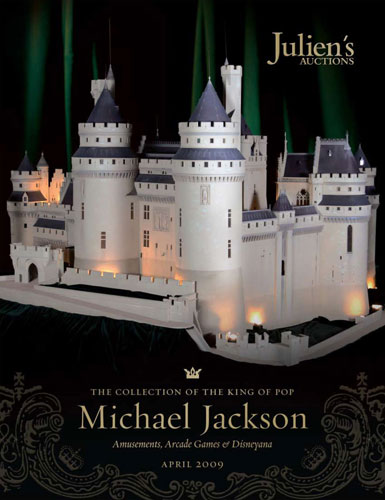
Michael Jackson Auction: Michael Jackson auction catalogue

In April, an auction by Julien's Auctions at the Beverley Hills Hilton will provide an unprecedented look into the private world of Michael Jackson. Observer Music Monthly has obtained this world exclusive preview of some of the items going under the hammer.

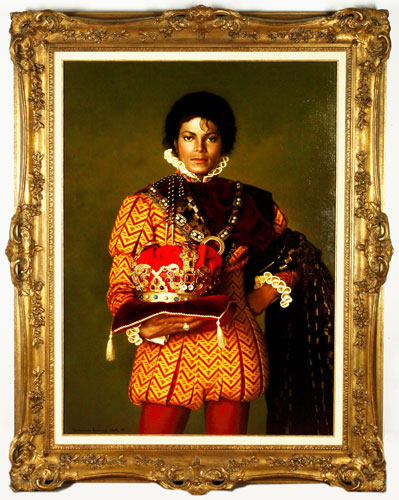
Michael Jackson's auction: Portrait of Michael Jackson dressed as a King

A portrait of Michael Jackson dressed as a king, oil on canvas, signed and dated 1995 and housed in an elaborate gold frame. Guide price $4,000-$6,000
Photograph: Shaan Kokin/Julien's Auctions


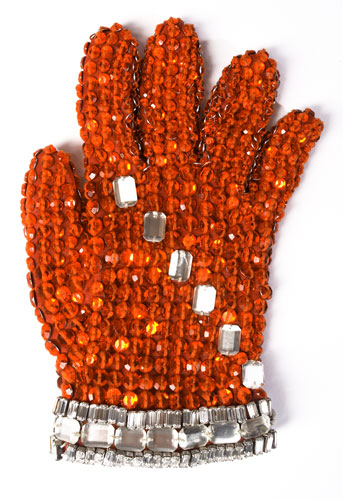
Michael Jackson's auction: Michael Jackson's spandex glove
An orange spandex glove covered with orange Swarovski Loch Rosen crystals and rectangular mirrored beads. Guide price $1,000-$1,500
Photograph: Shaan Kokin/Julien's Auctions


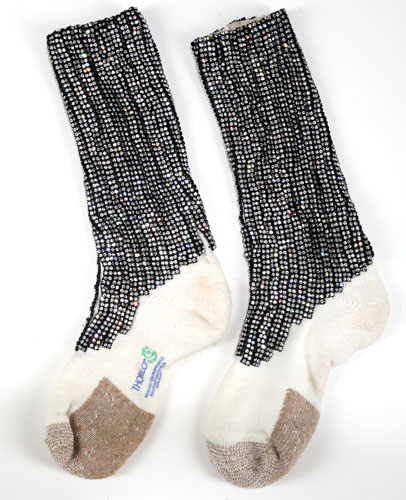
Michael Jackson's auction: Michael Jackson's triumph era socks

A pair of Michael Jackson's Triumph-era socks with uppers covered in rhinestone banding. They date back to his 1981 Triumph tour with the Jacksons. Guide price $600-$800
Photograph: Shaan Kokin/Julien's Auctions

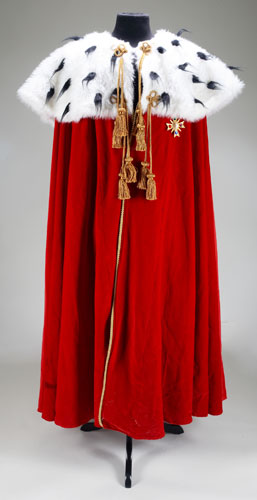
Michael Jackson's auction: Michael Jackson's velvet cape

A full-length red velvet cape with detachable faux ermine collar with gold rope trim, gold metal cross brooch with faux cabachon gems and satin lining. Guide price $300-$500
Photograph: Shaan Kokin/Julien's Auctions

Michael Jackson's auction: Michael Jackson's golf cart

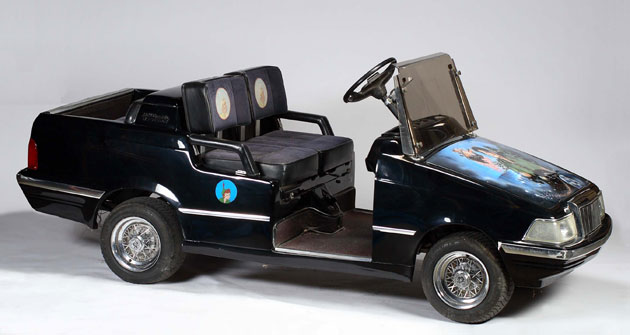
An electric cart featuring an image of Jackson as Peter Pan on the bonnet and Peter Pan cushions. Guide price $4,000-$6,000
Photograph: Shaan Kokin/Julien's Auctions

Michael Jackson's auction: Michael Jackson's golf cart

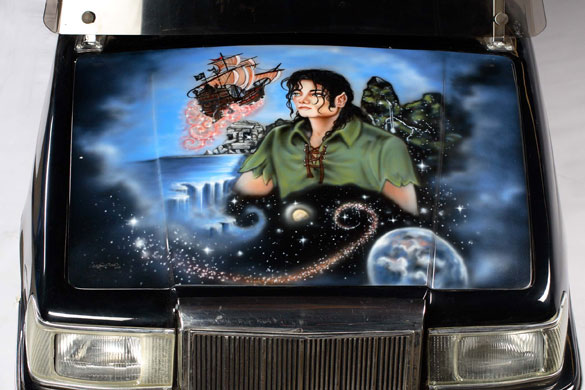
A close-up of the image of Jackson as Peter Pan
Photograph: Shaan Kokin/Julien's Auctions

Michael Jackson's auction: robotic Michael Jackson head

A robotic Michael Jackson head featured at the climax of his 1988 film Moonwalker, when he transforms into a robot and defeats Joe Pesci's evil character, Mr Big. Guide price $2,000-$3,000
Photograph: Shaan Kokin/Julien's Auctions


Michael Jackson's auction: robotic Michael Jackson head

The robotic head lights up as each piece of the face pushes out and expands before retracting back into the shape of Jackson's face. It still animates at the push of a button
Photograph: Shaan Kokin/Julien's Auctions

source: guardian.co.uk

See Part 2
See Part 3

Read the rest of this entry

Thursday, February 19, 2009

5 Things You Think Will Make You Happy (But Won't)

By David Wong, Elizabeth Benefiel

article image

If 80s movies taught us anything, it's that at some point you're going to run into a mysterious relic that lets you switch bodies with other people.

Would you use it? Would you choose to switch lives with, say, Brad Pitt or Angelina Jolie or Dale DeBone? Most people would.

But let's say the artifact doesn't let you choose, but will instead switch you randomly with one of the other six billion people on the planet. Virtually nobody will take that deal, for fear they'd switch with some poor villager in Nigeria.

So what does that say about us? Well, according to experts, it says almost everything we think about what would make us happy is dead wrong. Let's look at the five things we're most wrong about, with some pictures of adorable animals for good measure.

Click here to view article from source.

Read the rest of this entry

Friday, February 13, 2009

Diet Essentials For Everyone

I was browsing through Google Reader and I would just like to copy these 2 lists about healthy and unhealthy foods. No, I did not make this list myself but I want to have a copy here in my blog to serve as my personal reminders. Thanks to ThatsFit.com for these fantastic posts!

Diet Essentials For Everyone
10 Essential Diet Basics

Eat a diet full of color
Colorful fruits and vegetables are stocked with fiber, vitamins, minerals, and antioxidants. They're low in calories and can help you stay satisfied longer.

Eat whole grains
Unlike white products, whole grains are unrefined products with their nutrients and fiber intact. Make your grains 100% and they'll help you maintain blood sugar levels with less spiking and crashing throughout the day. They'll also keep you satisfied longer.

Eat good fats
Not all fats are bad. Some fats are good for us -- like olive oil instead of butter or margarine, and some nuts and seeds.

Eat often
Start with a hearty breakfast and commit to eating throughout the day to keep your metabolism stable. Aim for three meals a day, plus a few healthy snacks too.

Snack before meals
Snacking before dinner won't ruin your appetite. It may actually help it. Healthy snacking can prevent you from overeating come meal time.

Eat whole, fresh foods
Whenever possible, purchase fresh foods and avoid the pre-packaged items lining the shelves at your local grocery store. These foods are typically higher in calories, fat, and sodium and have depleted nutrients due to preservatives.

Keep moving
Our bodies were designed for movement. And we need daily exercise to keep them strong. Exercise is good for our muscles, our hearts, even our sleep patterns.

Treat yourself
It's OK to indulge once a while. If we don't, deprivation sets in and so might overindulgence. So have your cake -- just have it moderation.

Decipher food labels
Read your labels. And make sure when you review the details you understand whether the calories and fat listed are per serving or for the entire container. And if there's a word you can't pronounce, it's likely something you don't need to ingest.

Beware of liquid calories
One 12-ounce can of regular soda can contain 10 teaspoons of sugar and enough calories to ruin the day. Sure to add weight, these drinks should be replaced with water.


Surprisingly Unhealthy Foods

Pasta Salad
The veggies included in most pasta salad recipes is great, but the white-flour pasta is not (close relative to white bread).

Pretzels
They may be low in calories (around 110 calories per ounce) but they can raise your blood sugar faster than jelly beans or ice cream -- so be careful!

Baked Beans
Although beans are high in fiber (which can help you feel fuller) in baked bean recipes they're often covered in a sauce full of brown and white sugars -- 1 cup of baked beans can have as much sugar as an 8oz soda.

California Rolls
The seaweed wrap is full of essential nutrients, but the imitation crab and white rice are both high in carbs and low in protein. Men's Health calls California rolls "Japanese sugar cubes."

Low-Fat Salad Dressing
Taking the fat out of the dressing does drastically reduce its calorie count, but studies have shown that taking the fat out of a salad also reduces the nutrients and antioxidants a person absorbs. So it's better to go with a full-fat dressing made with olive oil or canola oil.

Yogurt with Fruit on the Bottom
Yogurt is healthy and fruit is healthy, but when you put the two together they almost never are. Cornsyrup is the culprit, causing the sugar content to go so high it pretty much cancels out any health benefits the yogurt had to start with.

Corn Oil
It has lots of Omega-6 fatty acids, but very few Omega-3s. Both are good for you, but studies show ingesting them out of balance can cause inflammation. Olive oils and canola oils are better choices because their fats are more balanced.

Granola Bars
While granola is made with whole oats (full of nutrients and fiber) in a granola bar they basically get glued to each other with sugar (corn syrup, honey, and barley malt).

Croutons
Croutons are usually made with refined flour -- which has a higher glycemic index than sugar. Thankfully they're tiny, so their negative impact usually is too.

Fruit Cocktail in a Can
Again, it's the sugar! Most fruit cocktails are canned in heavy syrup and can include as much as 23g of added sugar. Look for fruit canned in "100% fruit juice," or better yet make your own fresh fruit cocktail!

photo credit, jenny downing

Read the rest of this entry

Friday the 13th

Friday the 13th
It's Friday the 13th today and you might be extra careful going out since this day is traditionally found to be most unlucky for people. But how did Friday the 13th come about to have such an eerie reputation?

A Brief History of Friday the 13th


Face it, you're screwed. Today is Friday the 13th — the unluckiest day on the calendar — so try not to crash your car, fall down a flight of stairs, set yourself on fire, or do anything else that might compromise your well-being. And for God's sake, stay away from men in hockey masks.

The number 13 has been unlucky for centuries. Some historians peg the superstition to the thirteen people who attended the Last Supper (neither Jesus nor Judas came out of that one OK), but ancient Babylon's Code of Hammurabi omits the number 13 in its list of laws, so the superstition dates back to at least 1700 BC. Thirteen is so unlucky, in fact, that in 1881 an organization called The Thirteen Club attempted to improve the number's bad reputation. At the first meeting, the members (all 13 of them) walked under ladders to enter a room covered with spilled salt. The club lasted for many years and grew to over 400 members, including five U.S. presidents: Chester Arthur, Grover Cleveland, Benjamin Harrison, William McKinley and Theodore Roosevelt. Despite the club's efforts, triskaidekaphobia (that's fear of the number 13) flourished; even today, most tall buildings don't have a 13th floor.

The number's association with Friday, however, didn't take hold until the 20th century. In 1907, eccentric Boston stockbroker Thomas Lawson published a book called Friday the Thirteenth, which told of an evil businessman's attempt to crash the stock market on the unluckiest day of the month. Thanks to an extensive ad campaign, the book sold well: nearly 28,000 copies within the first week. In 1916, the book was turned into a feature-length silent film.

Wall Street's superstitions about Friday the 13th continued through 1925, when the New York Times noted that people "would no more buy or sell a share of stock today than they would walk under a ladder or kick a black cat out of their path." Some stock traders also blamed Black Monday — Oct. 19, 1987 — on the fact that three Fridays fell on the thirteenth that year. The Stress Management Center and Phobia Institute estimates that $700-$800 million dollars are lost every Friday the 13th due to people's refusal to travel, purchase major items, or conduct business.

Then came Jason. In 1980, Paramount Pictures released Friday the 13th (tagline: "Fridays will never be the same again"), a slasher flick about a series of murders at a summer camp. Apparently Jason, born on Friday the 13th, chooses that date to take revenge on oversexed campers much like the ones who allowed him to drown in Crystal Lake. So much for trust falls and lanyard making.

Friday the 13th grossed almost $40 million at the box office and inspired a long-running franchise: Friday the 13th Part II; Friday the 13th Part III; Friday the 13th: The Final Chapter (it was not); Friday the 13th: Jason Lives; Friday the 13th: The New Blood; Friday the 13th: Jason Takes Manhattan (he left the summer camp?); Jason Goes to Hell: The Final Friday; Jason X; and 2003's Freddy vs. Jason. Maybe the number 13 isn't so bad afterall.

Friday the 13th Myths:

• If you cut your hair on Friday the 13th, someone in your family will die.
• A child born on Friday the 13th will be unlucky for life.
• If a funeral procession passes you on Friday the 13th, you will be the next to die.

Friday the 13th Anecdotes:

•In 1913, a New York pastor tried to assuage couples' fears by offering to marry them for free on Friday the 13th.
• In 1939, a small town in Indiana forced all black cats to wear bells on Friday, October 13th. When the measure seemed to work (nothing bad happened, at any rate) the town continued the practice for the next three years.
•At the time, October 13, 1989 was the second largest Dow drop in history. Nicknamed the "Friday the 13th mini-crash," these days it's not even in the top 10. That might be the scariest fact of all.


Article Source: Time.com

Read the rest of this entry

Tuesday, January 20, 2009

35 Wackiest Weirdest Barack Obama Merchandise You Can Actually Buy

Obama Merchandise
Obama glow in the dark ref magnet. Obama vulcan. Obama lighter. Obama wristwatch. Obama doll...


Click here to view article from source

See more Obama merchandise from cracked.com

You can also check out these Obama merchandise from Amazon:

Read the rest of this entry

Wednesday, December 31, 2008

TipsBase, A Place To Share Tips And Tricks About Anything

by Robin Wauters

TipsBase is a new social network centered around sharing tips and tricks about a wide variety of topics, counting on user-generated content to populate the community site with interesting tidbits on why and how to do (or not do) certain things. The team behind the website likened it to a ‘YouTube for tips’, but that’s quite the overstatement.

TipsBase says it’s different from the crowded space of How To websites and other social networks where tips are shared via message boards and the likes, by providing a centralized platform where registered users can share short, practical advice about any topic ranging from business, computers and video games to fashion, pets, gambling and health. There’s also a social layer on top of it, where you can do classical social networking stuff like befriend people, subscribe to their tips, comment on articles, send direct messages, rate content, etc. This is similar to what Tipstrs is all about.

The team is convinced that users will benefit from the fact that TipsBase covers so many categories, but I tend to think niche communities or websites dedicated to tips and tricks about a limited set of topics work better. There are better resources for finding tips and tricks about video games, for instance, and I’m not even going to consider looking for tips on health or personal finance on a general website like TipsBase.

They’re also going to have a hell of a time moderating incoming tips (see second screenshot for example). Having your community flag spam and adult material is one thing, but I think the quality of the tips is what would make users come back for more, and there’s no way to assure that when all it takes for people to start sharing tips is providing their e-mail address and picking a password.

Read the rest of this entry

The 5 Creepiest Urban Legends (That Happen to be True)

By Nathan Birch
Click here to view article from original source

The best creepy campfire stories are always the ones that end with the words, "...And it’s all true, because I have the damned documentation here to prove it!"

In that spirit, we've tracked down five of the creepiest tales and urban legends that really happened to real people, proving once and for all that nothing is more terrifying than everyday life.

The Dead Body Under Your Freaking Matress

The Legend:
A couple checks into a hotel and have to put up with a foul odor in their room all night. They call the staff to complain and somebody figures out the stench is coming from the bed.

Now, there's no way that scenario is going to have a good ending. You're almost hoping at that point that it'll turn out the last guest just got drunk and pooped behind the headboard. But, no, the staff take off the matress and discover the couple has been sleeping over the rotting body of a dead girl who had been stuffed in the box spring.

The Truth:
This actually happened, in Las Vegas. Also, Kansas City, MO and Atlantic City, NJ and several times in Florida and California and, well, let's just say that in or under the bed in a hotel room seems to be a fairly popular destination for the recently deceased.

It makes sense if you think about it. The closet and under the bed are the two most popular places to hide just about anything, so it's not surprising a hell of a lot of corpses end up there as well. In fact, the odds are pretty good that at least once a guy has killed a prostitute, tried to stuff her under the bed, only to find there was already a body there.

The strangest part isn't that the bodies wind up in such a terrible hiding place (killers often aren't the type to plan ahead). No, the strange thing is that in almost every story people will sleep part of, or in many cases, the entire night, on top of the corpse before reporting it.

Most people we know will complain if they detect that someone might have smoked a cigarette in their room four months ago. Not these people, they slept inches above an oozing heap of rotting human flesh rather than inconvenience the hotel management by asking for a new room.

Or, at least we hope sleeping is all they did on that bed. Oh, man, can you imagine dying and then the first thing that happens is some middle age couple starts porking over you? Ew.

Hopefully they at least got a free continental breakfast out of the ordeal.

The Funhouse Mummy

The Myth:
A prop at a carnival was discovered not to be made of the usual combination of papier mache and carni spit, but human skin and bone. All the little kiddies at the haunted house had been poking and giggling at a real, mummified dead body.

The Truth:
Apparently the smell wasn’t just coming from the convict manning the corndog stand. Back in 1976, a camera crew filming an episode of The Six Million Dollar Man began to set up in the haunted house at the Nu-Pike Amusement Park in Long Beach, Calif.

As they were moving aside a "hanging man" prop, they accidentally knocked off its arm and discovered human bones inside. Bionic, this poor sap wasn’t.

The story gets stranger. The body was actually that of criminal mastermind Elmer McCurdy, who was killed in a shootout after robbing a train in 1911. The princely sum old Elmer got killed for? $46 (and two jugs of whiskey).

McCurdy was embalmed by the local undertaker, and apparently the guy was so darn pleased with his work that he propped up the corpse in the funeral home as evidence of his skills. People were charged 5 cents to see the corpse, which they paid by dropping a nickel in the cadaver’s mouth. Remember that little bit of history the next time somebody turns their nose up at you for liking Hostel 2.

Think it can’t get any stranger? Oh, you naïve fool. After several years of raking in the nickels (how exactly these coins were retrieved after being dropped into the corpse’s mouth is something probably best left to the imagination) our enterprising undertaker’s scheme was ruined when McCurdy's brothers showed up to claim him. Of course, these guys weren’t his brothers at all, but wily carnival promoters. From that point on, McCurdy’s mummy went on a morbid mystery tour all around America, popping up at carnivals all over the country before finally coming to rest in Long Beach.

McCurdy is now buried in Oklahoma. Because McCurdy apparently had the most entertaining corpse in history, they prevented anyone else from taking him on tour by dumping concrete on top of the casket. No, really.

The Curiously Realistic Decoration

The Legend:
What was thought to be your typically charming Halloween decoration depicting a lynched woman hanging from a tree, turns out to be a genuine suicide.

The Truth:
In the town of Frederica, Delaware, a 42-year-old woman, perhaps distraught by the fact that she lived in Delaware, hung herself from a tree near a busy road on a Tuesday night. The body managed to hang there until the next day and was viewed by many unwitting (or perhaps retarded) spectators before somebody realized it wasn't a decoration and finally called the police.

Once again it's the lack of complaints from passers-by that amaze us. Even if the hanging thing wasn't a body, it was something that looked exactly like one and would be considered an extremely distasteful Halloween decoration (unless she put on a wacky witch's costume before doing the deed).

With the political correctness these days, you'd have expected two special city council meetings and 30 letters to the editor within the first ten minutes of someone seeing it.

We can't help but wonder, if the person who eventually called the police hadn't bothered, how much longer would the body have hung there? This happened five days before Halloween. Add five days of decomposition to the equation and suddenly you have something a whole lot more terrifying.

Also, did the woman plan this? She knew what time of year it was, and intentionally hung herself in a public place. Did she want her corpse to blend in with the bed sheet ghosts and stuffed witches around the neighborhood? If so, it sounds like she may have been a fascinating person.

A Halloween Stunt Goes Wrong in the Least Surprising Way Possible

The Legend:
A teenager manages to provide the Halloween show he’s in with the ultimate finale when, while pretending to hang himself in front of the audience, he actually hangs himself.

The Truth:
While the fine citizens of Frederica we discussed were perhaps a bit slow on the uptake, the people involved in this hanging-related legend are on the dipshit honor roll. Mainly because it's happened more than once.

Yes, people have repeatedly tried to pull off an imitation hanging for a Halloween show, forgot to include the "imitation" part and went ahead and accidentally killed themselves. Yes, they were pretty much all teenage males.

In one instance, an entire working gallows was built for a show, with the "victim" secured by a harness so that he’d stop just short of actually being hung (take a wild guess how that turned out). Now we’re just thinking aloud here, but if we were standing on a gallows, fake or not, with a rope around our necks, we’d want to take a few precautions. For example, and again just blue-skying, maybe don’t use a real rope that is tied into a real noose that is wrapped around your real neck in a way that could really kill you.

Perhaps the saddest thing about the story was how completely unnecessary the whole thing was. Here’s a tip for anyone trying to thrill kids on Halloween in the future: You don’t need to hang yourself. Just give out full-sized chocolate bars instead of those not-so-fun "fun-sized" ones. We can guarantee the tykes will be talking about the house that gave out full-sized Snickers bars long after some life-risking stunt was forgotten.

The Legend:
Some poor schmuck is committed to his or her eternal resting place, even though they aren’t quite ready to take that final dirt nap. Scratch marks are later found on the coffin lid along with other desperate signs of escape.

The Truth:
This not only happened, but back in the day it happened with alarming regularity. In the late 19th century, William Tebb tried to compile all the instances of premature burial from medical sources of the day. He managed to collect 219 cases of near-premature burial, 149 cases of actual premature burial and a dozen cases where dissection or embalming had begun on a not-yet-deceased body.

Now, this may seem ridiculous, but keep in mind this was an era before doctors such as the esteemed Dr. Gregory House gained the ability to solve any ailment within 42 minutes. If you went to the doctor with the flu in those days, he’d likely cover you in leeches and prescribe you heroin to suppress your cough. Their only method for determining if a person had died was to lean over their face and scream "WAKE UP" over and over again. If you didn't react, they buried you.

The concern over being buried alive back then was so real that the must-have hot-ticket item for the wealthy and paranoid were "safety coffins" that allowed those inside to signal to the outside world (usually by ringing a bell or raising some type of flag) should they awake 6-feet under. Though, answering that bell sounds like a good way to get ambushed by a zombie if you ask us.

Unfortunately safety coffins aren’t in vogue anymore, so if you’re at the cemetery and hear a muffled voice calling out "OK guys, joke’s over. Let me out!" it might be a good idea to inform someone with a shovel quickly.

Of course, that last sentence was merely facetious, there’s no way something like this could still happen today. Uh, well, except for this story about a Venezuelan man waking up during his autopsy. On second thought, you might want to consider adding a line in your will that states you’re to be buried with a gas-powered auger in your casket when you go.

Nathan Birch also writes the disgustingly cute webcomic Zoology.

Read the rest of this entry
Important Privacy Notice:
Starting May, Google will have access to your internet usage via a cookie. This cookie will help Google provide the most appropriate ads for my blog, and any other website using Google Adsense, basing on your internet history. For example, if you frequent websites about Blogging, Health and Fitness, or Personal Finance, Google will show health or finance related ads in my blog, and any other website using Google Adsense. The reasoning is that you will be more interested in these ads and will help you find what you are possibly looking for.

For more information about these changes and how it affects our privacy, go to Google Privacy Center. Also, if you think these changes are not acceptable for you, there is a blue "opt out" button you can click. If you opt out, you will still see Google ads in my blog, but they will be based on the content of my posts, not on your personal internet history.

Please take time to read more. Whatever you do, make sure you understand the effects to your privacy.

  © Blogger template 'External' by Ourblogtemplates.com 2008

Back to TOP